
 English
 简体中文
 Spanish
 Norwegian
 Portuguese
 Vietnamese
 Deutsch
 French
 Indonesian
 Russian
 Japanese
 Korean
 Dutch
 Italian
 Thai
How Light Spectrum Drives Fish Growth in Land-Based Farms
The global aquaculture industry is changing rapidly. As demand for seafood rises, production is moving inland. Today, land-based fish farms use advanced technology to raise healthy fish in controlled environments. The most important innovation in this sector is the Recirculating Aquaculture System (RAS).
In a RAS facility, every environmental factor is carefully managed. Farmers control water temperature, oxygen levels, and water filtration. However, there is one critical factor that is often overlooked: light.
Light is not just for visibility. For fish, light is a biological trigger. By understanding and controlling the light spectrum (the different colors of light), modern fish farms can significantly improve fish growth, behavior, and health. This article explores how specific light spectrums optimize the farming of two high-value species: Atlantic salmon and rainbow trout.
The Biology of Light in Aquaculture
In nature, water filters sunlight. Red and yellow light disappear in the first few meters of water. Blue and green light travel the deepest. Because fish evolved in these underwater environments, their eyes and brains are highly sensitive to specific colors.
In land-based fish farms, traditional lights often emit a wide, generic spectrum. This can stress the fish. By using custom LED technology, farmers can now deliver specific light spectrums. This practice is known as applying a "light recipe."
When fish receive the correct light spectrum, their bodies produce less cortisol (the stress hormone) and more melatonin (the hormone that regulates sleep cycles). Lower stress means healthier fish, and healthier fish grow much faster.
Atlantic Salmon (Managing Maturity and Growth)
Atlantic salmon is the most popular species in modern RAS facilities. One of the biggest challenges in salmon farming is early maturation. If a salmon matures too early, its growth stops, and the quality of its meat drops.
Light plays a vital role in preventing early maturation. Salmon rely on a specific photoperiod—the cycle of light and darkness—to understand the season.
· The Power of Blue and Green Spectrum: Research shows that Atlantic salmon respond best to blue and green light. These wavelengths penetrate the water deeply and evenly.
· Controlling the Photoperiod: By combining continuous blue-green light with a strict 24-hour photoperiod during the early growth stages, farmers can trick the salmon's brain. The fish believe it is always summer.
· The Result: This light recipe delays early sexual maturity. Instead of wasting energy on reproduction, the salmon focus all their energy on muscle growth. This significantly reduces the time needed to reach market weight.
Rainbow Trout (Improving Feeding Behavior)
Rainbow trout are very active, visual predators. They need to see their food clearly to eat efficiently. In indoor land-based fish farms, bad lighting can cause uneven feeding behavior. Strong fish eat too much, while weaker fish starve.
· The Power of the Red-Green Spectrum: While blue light helps salmon, rainbow trout benefit greatly from a carefully balanced green and soft red spectrum.
· Better Visibility and Calmness: Green light provides excellent contrast in water. It helps the trout see the floating feed pellets easily. At the same time, the correct spectrum keeps the trout calm, reducing aggressive behavior and fin-nipping during feeding times.
· The Result: When trout see their food clearly and feel calm, the entire school eats evenly. There is less wasted feed at the bottom of the tank, and the fish grow at a uniform, predictable rate.
Optimizing the FCR
In aquaculture, the most critical financial metric is the Feed Conversion Ratio (FCR). The FCR measures how many kilograms of feed are required to produce one kilogram of fish. A lower FCR means the farm is highly efficient, uses less feed, and saves money.
Optimized lighting directly improves the FCR in three clear steps:
1. Reduced Stress: Stressed fish burn energy simply trying to survive. Calm fish under the correct light spectrum use their energy to build muscle.
2. Better Feeding Habits: As seen with rainbow trout, the right light spectrum ensures that fish locate and consume feed immediately, preventing feed waste.
3. Balanced Metabolism: The right light cycle stabilizes the digestive system of the fish, allowing them to absorb nutrients from the feed more effectively.
By combining the perfect light spectrum with a stable photoperiod, RAS operators can achieve an optimal FCR, making the entire farming process much more sustainable.
The Smart Solution for Advanced Light Management
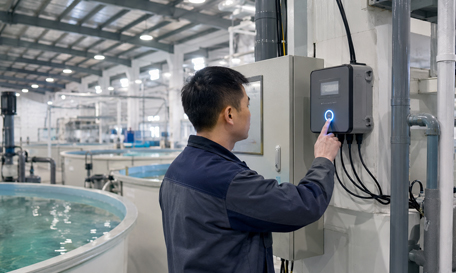
To help land-based fish farms achieve perfect spectrum control, Hontech-Aqua has engineered a cutting-edge lighting and automation ecosystem. Designed specifically for the rigorous demands of RAS environments, our technology bridges the gap between fish biology and operational simplicity.
Advanced Control System Features:
· 0-100% Flicker-Free Dimming: Eliminates sudden light shocks. The ultra-smooth dimming curve perfectly mimics natural sunrise and sunset, completely preventing fish panic and stress.
· 20+1 Channel Multi-Zone Control: Allows managers to run different "light recipes" and photoperiod schedules across multiple tanks or life-stages simultaneously.
· 24/7 Smart Monitoring & Fault Alerts: Offers around-the-clock peace of mind. The system tracks lighting performance in real-time and sends instant alerts if any anomaly occurs.
· Seamless Triple-Network Link: Connects effortlessly via 4G LTE, Wi-Fi, or Bluetooth, ensuring stable communication and remote management from anywhere in the world.
· Easy Installation & Zero Control Wiring: Reduces setup costs and complexity. The wireless control architecture means zero signal wires, simplifying your farm's infrastructure.
Marine-Grade Hardware Built for Longevity:
· IP67 Waterproof Certification: Fully sealed against heavy water splashes and high-humidity indoor environments.
Biofouling-Resistant & Easy Clean: The smooth, specialized housing limits organic buildup and is designed for effortless cleaning, drastically reducing manual maintenance hours.
Latest news
-
-
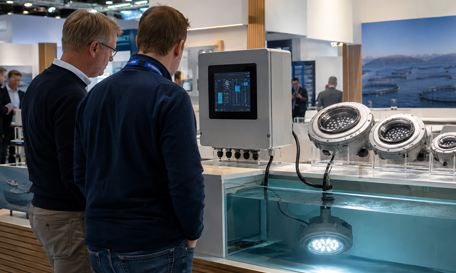
Press Release: Hontech-Aqua to Showcase Next-Gen Intelligent Lighting at Nor-Fishing 2026 (Hall C, Stand C-012)
Read More